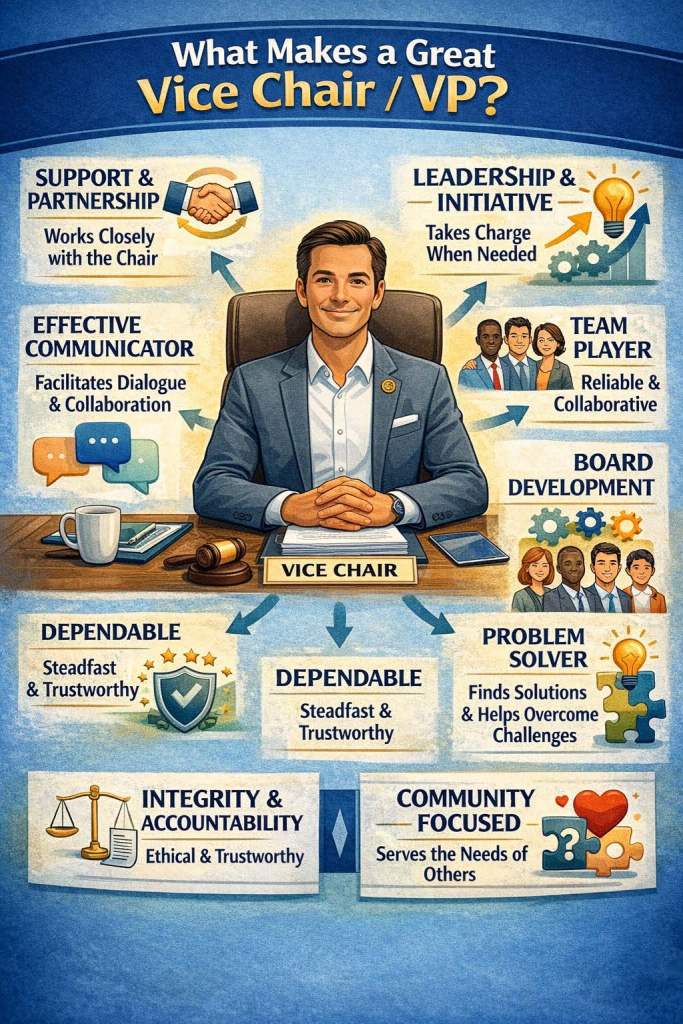
We discussed the Board Chair (or President) in our last blog —The Heart of Great Governance: What Makes an Outstanding Nonprofit Board Chair (or President). But right beside them, often in the background, sits the Vice Chair (or Vice President). This role gets overlooked far too often: “It’s just backup,” boards think. “We’ll figure it out if the Chair is away.”
The truth? A thoughtful, engaged Vice Chair isn’t a spare tire—it’s a strategic asset that lightens the load on the Chair, builds leadership depth, and ensures smooth transitions when the time comes. In volunteer-driven nonprofits—where everyone is juggling real jobs, families, and passions—having a solid #2 prevents burnout, gaps in leadership, and rushed decisions during change.
Especially in Canadian nonprofits (under rules like Alberta’s Societies Act, Agricultural Societies Act, and Cooperative Act), where boards must maintain continuity and accountability, the Vice Chair role deserves more attention. Here’s what makes an effective Vice Chair stand out, and why investing in this position pays off big for your organization’s long-term health.
1. The Reliable Stand-In: Ensuring No Leadership Vacuum
At minimum, the Vice Chair steps in seamlessly when the Chair is absent—chairing meetings, signing documents, or representing the board. But great Vice Chairs go beyond “just in case.” They prepare by shadowing the Chair, understanding agendas, staying fully briefed and by engaging in good discussion with the Chair.
Why it’s crucial: Life happens—illness, travel, family emergencies. A prepared Vice Chair keeps momentum going, so the board never stalls.
2. Succession Planning Built In (The Long-Game Leader)
The smartest boards treat the Vice Chair as Chair-in-training. This isn’t automatic (some organizations now elect Chairs openly each term), but it’s a proven way to groom future leadership. A strong Vice Chair gains hands-on experience: facilitating discussions, managing dynamics, and thinking strategically.
Real impact: When the Chair’s term ends (or they step away), the transition is smooth—no scramble for a new leader, no loss of institutional knowledge. This continuity is gold for mission-driven work.
3. Workload Sharer: Lightening the Chair’s Burden
Chairing is demanding—prepping agendas, following up on actions, liaising with the ED/CEO, handling sensitive issues. A proactive Vice Chair splits the load: co-chairing committees, leading special projects (like governance reviews or recruitment), or focusing on board development (orientation, engagement).
Bonus: This partnership prevents Chair burnout and models healthy collaboration for the whole board.
4. Bridge-Builder and Voice for the Board
Vice Chairs often serve on the executive committee (if one exists) and act as a sounding board for the Chair. They can champion quieter members’ ideas, spot emerging issues, or facilitate tough conversations. Many take on governance-focused tasks—updating policies, refreshing bylaws, or leading recruitment—to keep the board healthy.
In smaller or rural groups: Where boards are volunteer-heavy and resources limited, a Vice Chair who focuses on people and processes can make a huge difference in retention and effectiveness.
5. Key Qualities of an Outstanding Vice Chair
- Commitment & Readiness: Wants the role, shows up prepared, and is willing to learn Chair duties.
- Collaboration: Supports without overshadowing; partners with the Chair and ED/CEO.
- Facilitation Skills: Reads the room, encourages participation, keeps things on track.
- Forward-Thinking: Keeps an eye on the future—succession, board refresh, strategic needs.
- Reliability & Humility: Steps up when needed, steps back gracefully, gives credit freely.
Volunteering in leadership isn’t easy—especially when it’s unpaid and layered on top of everything else. A well-defined Vice Chair role respects that by distributing responsibility and preparing the next generation of leaders.
If your bylaws don’t clearly define the Vice Chair (or if the role feels vague in practice), it’s worth clarifying. Many boards update officer descriptions to include specific duties, succession expectations, and special assignments—making the position more meaningful and attractive.
At Pen to Anvil, we help boards strengthen these roles: crafting clear job descriptions, facilitating leadership transitions, or designing succession frameworks tailored to your size and context. A quick review can turn an “overlooked” position into a powerhouse for sustainability.
Don’t let your board’s leadership depth be an afterthought. A strong Vice Chair today means a resilient organization tomorrow.
What’s your experience with the Vice Chair role—has it been a game-changer, or does it need more definition on your board? Drop a comment—we’re all learning!

 Pen to Anvil Advisors
Leave a comment