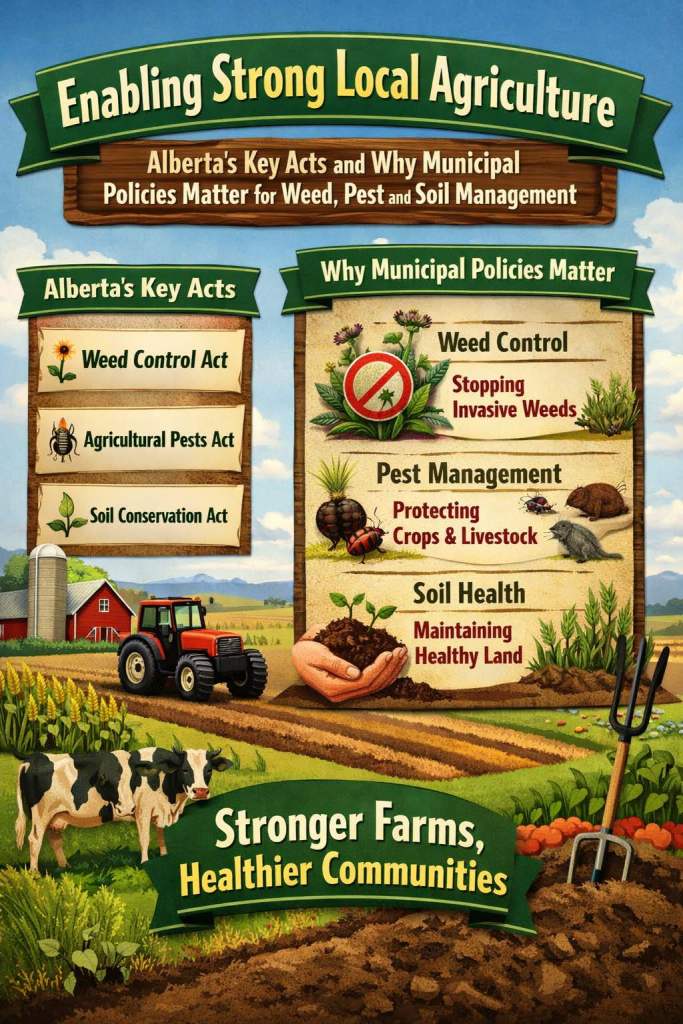
In rural Alberta, whether in small municipality like Crowsnest Pass or a large one like Mackenzie County, agriculture thrives when land is protected from invasive threats, pests, and soil degradation. Three cornerstone pieces of provincial legislation provide the framework: the Weed Control Act, the Agricultural Pests Act, and the Soil Conservation Act. These acts are “enabling”—they set a provincial legislative framework that lays out standards and duties and delegate much of the prioritization, implementation, and enforcement to municipalities through Agricultural Service Boards (ASBs) and local policies.
Without clear municipal policies, these acts can lead to confusion, inconsistent enforcement, disputes between neighbors, or missed opportunities to protect shared resources. Well-crafted local policies create transparency: clear expectations for landowners, defined limitations on actions (e.g., methods, timelines), and fair consequences for non-compliance. This approach, respects landowner’s time, builds community trust, and safeguards Alberta’s agricultural future.
1. The Weed Control Act: Preventing Invasive Spread
Enacted as one of Alberta’s oldest laws (with updates as recent as 2025), the Weed Control Act (RSA 2000, c W-5.1) requires landowners to control noxious weeds (inhibit growth/spread) and destroy prohibited noxious weeds (kill all parts, render seeds non-viable). It lists regulated species and prohibits spreading weeds via equipment, seed, or refuse.
Municipalities play the lead role: appointing inspectors who inspect properties, issue correspondence and notices, and enforce compliance. Local authorities can even designate additional weeds via bylaw (with ministerial approval).
Why municipal policies are essential:
- Set clear timelines for control/destruction after notices.
- Define approved methods (e.g., mechanical, chemical, cultural) and safety limitations.
- Outline consequences (e.g., municipal action at owner’s expense and/or fines).
- Promote education and prevention over punishment.
Without policies, enforcement feels arbitrary; with them, landowners know exactly what’s expected, reducing conflicts and encouraging proactive management.
2. The Agricultural Pests Act: Managing Threats to Livestock and Crops
The Agricultural Pests Act (RSA 2000, c A-8) empowers the Minister to declare pests or nuisances (animals, birds, insects, plants, diseases) that harm land, livestock, or property. Landowners must prevent establishment, control, or destroy them; local authorities support enforcement.
Recent examples include wild boar as a declared pest (updated 2025) and ongoing issues like clubroot or other infestations.
Municipalities (via ASBs and fieldmen/inspectors) conduct surveys, issue notices, and recover costs if needed.
Why municipal policies matter:
- Clarify local priorities (e.g., specific pests of concern in the area).
- Establish notification protocols, inspection schedules, and appeal processes.
- Define limitations (e.g., quarantine zones, movement restrictions).
- Specify consequences (e.g., detention orders, fines, stop orders) to ensure fairness.
Policies turn provincial authority into community-tailored action, preventing widespread damage while supporting farmers.
3. The Soil Conservation Act: Protecting the Land Base
The Soil Conservation Act (RSA 2000, c S-15) requires every landholder to prevent or stop soil loss/deterioration from wind/water erosion, compaction, or other causes—preserving Alberta’s productive farmland for future generations.
Municipalities enforce via ASBs: issuing notices, taking action if needed, and recovering costs.
Why municipal policies are vital:
- Outline best practices (e.g., cover crops, reduced tillage, windbreaks) and thresholds for action.
- Set clear expectations for compliance (e.g., timelines after notices).
- Define limitations (e.g., when municipal intervention occurs) and consequences (e.g., penalties, cost recovery).
- Encourage education and incentives over enforcement alone.
In rural Alberta, where soil is the foundation of livelihoods, policies foster stewardship and prevent costly degradation.
The Power of Clear Municipal Policies: Expectations, Limitations, Consequences
These acts place primary responsibility on landowners but rely on municipalities for effective delivery. Strong local policies bridge the gap by:
- Setting Expectations — Landowners know duties, timelines, and resources (e.g., cost-share programs).
- Defining Limitations — Approved methods, notice procedures, appeals, and inspector powers prevent overreach.
- Outlining Consequences — Graduated responses (warnings → notices → municipal action → fines) ensure fairness and deter non-compliance.
Without them, enforcement can be inconsistent, leading to neighbor disputes or uneven protection. With them, communities build trust, reduce risks, and support sustainable agriculture.
At Pen to Anvil, we help rural municipalities and boards develop or refresh these policies: reviewing acts for compliance, crafting templates, facilitating ASB input, and ensuring they’re practical for small/volunteer teams. A clear policy framework honors landowners’ efforts and protects shared resources.
If your municipality or board is updating weed/pest/soil policies—or facing enforcement questions—reach out for a no-obligation chat. Let’s make governance clearer and more effective.
What’s one challenge your community faces with these acts, or how have local policies helped? Share in the comments!

 Pen to Anvil Advisors
Leave a comment