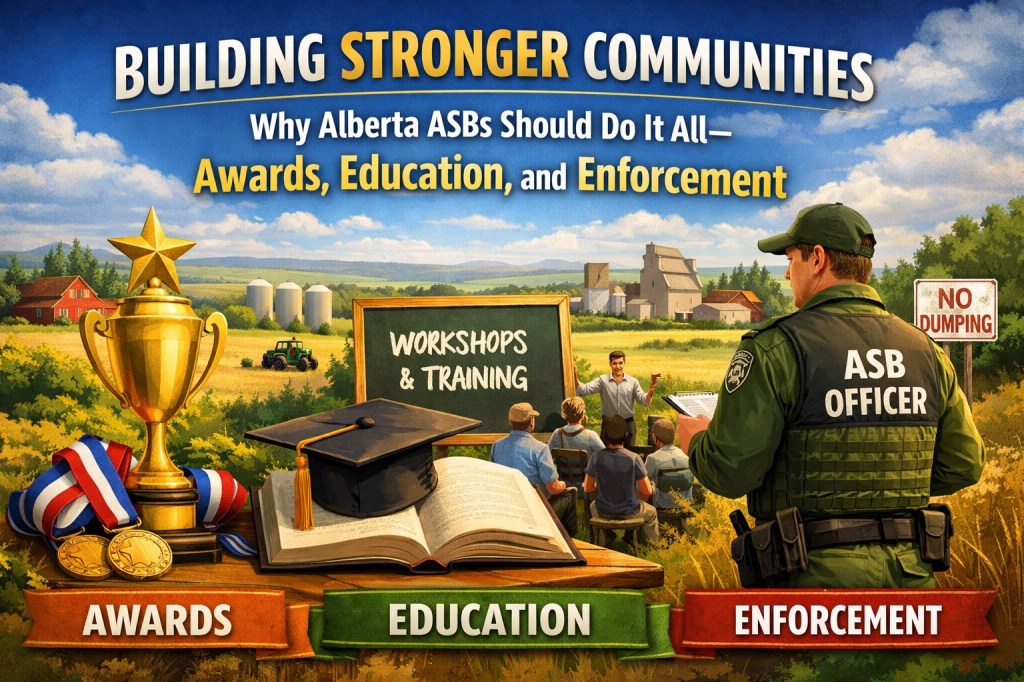
If you spend any time around rural Alberta municipalities, you’ve seen the pattern. The Agricultural Service Board (ASB) proudly announces its annual Farm Family Award winner—complete with plaques, photos in the local paper, and a feel-good story about multi-generational stewardship. Everyone claps. The board gets credit for “supporting agriculture.” Meanwhile, the same board quietly ignores its actual legislated job: creating policy for weed control, pest management, and soil conservation rules that keep invasive species from eating everyone else’s livelihood.
This isn’t laziness or malice in most cases. It’s a classic case of boards treating enabling legislation like a buffet—loading up on the dessert (awards, grants, community events) while leaving the vegetables (enforcement) untouched.
Let’s call it what it is.
The Law That Actually Created These Boards
The Agricultural Service Board Act was passed in 1945 after a successful pilot in what are now Rocky View County and Red Deer County. It is explicitly enabling legislation—not mandatory. Municipal councils can choose to adopt it by bylaw and make it binding, or they can keep it optional. The 1997 revisions made it even more flexible, letting councils decide board structure and membership.
The Act does three key things:
- Establishes the ASB as an advisory body to council and the Minister.
- Transfers enforcement authority for provincial statutes directly to the ASB.
- Allows cost-sharing agreements with the province for approved programs.
Those “provincial statutes” aren’t suggestions. They include:
- The Weed Control Act (noxious and prohibited noxious weeds—landowners must control them; inspectors can enter, issue notices, order control, recover costs, and fine non-compliance).
- The Agricultural Pests Act (declared pests, quarantine powers, inspectors, appeal processes).
- The Soil Conservation Act (erosion control, topsoil removal permits, remediation orders).
The Animal Health Act also gives ASBs reporting and assistance roles. The enabling legislation hands local boards real teeth—including the power to take land under municipal supervision if a landowner refuses to act.
This isn’t optional window dressing. The whole point of the 1945 Act was to get weed and soil problems under control after the Dust Bowl and wartime pressures. Enforcement was the core mandate from day one.
The Reality on the Ground
Walk into many ASB meeting across this province or check their annual reports and you’ll see glowing coverage of:
- Farm Family or Master Farm Family Awards
- 4-H scholarships
- Equipment rental programs
- Grant administration
- Trade-show booths
- “Sustainable agriculture” workshops
All valuable. None of them are the legislated duty that justifies the board’s existence and the public money that supports it.
Enforcement? Crickets. Or, at best, “We prefer education over regulation.” Translation: we don’t want the phone calls, the angry landowners, or the optics of “picking on” neighbours.
Meanwhile, Canada thistle, leafy spurge, and clubroot keep spreading across municipal boundaries. Oil and gas sites become weed reservoirs because enforcement is “too hard.” Beavers dam drainage systems because nobody wants to issue the order. The very producers the board claims to champion lose yield, market access, and soil health while the board pats itself on the back for another nice award ceremony.
Enabling Legislation Is a Two-Way Street
The beauty of enabling legislation is that it gives local people—elected councillors and appointed board members—the tools to act quickly and appropriately for their region. The curse is that it also lets them do almost nothing if they choose the path of least resistance.
If a council never passes the binding bylaw, or if the ASB never appoints and backs its inspectors, the legislation might as well not exist. And the weeds don’t care about good intentions or press releases.
Time to Forge Something Stronger
Alberta’s 69 ASBs serve nearly 60,000 farms and ranches across more than 50 million acres. That’s real power—if they choose to use it.
Boards that only want the easy, visible stuff should be honest: they’re running a community club, not fulfilling the legislative mandate that justifies their existence and provincial grant funding.
The ones willing to do both—the awards and the enforcement—are the ones truly protecting agriculture for the next generation. I’ve seen it firsthand, and I’m proud to have been involved with one such board. This ambitious and proactive ASB didn’t shy away from the tough stuff: they tackled persistent weed infestations, enforced pest controls where needed, navigated landowner challenges head-on, and backed their field staff through difficult decisions. By combining education, community outreach, and consistent enforcement, they turned potential conflicts into measurable wins—reduced spread of noxious weeds across boundaries, healthier fields for producers, and stronger cross-municipal cooperation. Overcoming those hurdles wasn’t easy, but the outcomes speak for themselves: more sustainable land, protected yields, and a real legacy of stewardship. Boards like this show what’s possible when we embrace the full mandate the legislation provides. They’re not just good—they’re great, and they’re proof that stepping up on enforcement builds stronger agriculture for everyone.
The legislation already enables it. The question is whether the boards—and the councils that appoint them—have the courage to use what the law gave them.
Because handing out another Farm Family Award feels good. But letting noxious weeds march across the countryside while you do it? That’s not leadership. That’s just enabling the problem the legislation was written to solve.
What do you think—should councils make the ASB Act binding everywhere and demand real enforcement numbers? Or is “education only” enough in 2026?
Drop your thoughts in the comments. The iron is hot—let’s hammer this out.

 Pen to Anvil Advisors
Leave a comment